

How do you separate fact from feeling?
Just as thoughts aren’t facts, feelings aren’t either. Emotions provide information, but when that information is intense and loud, we become more vulnerable to believing it reflects reality. We often think, 'I feel it, so it must be true,' but that’s not always the case.
Just as thoughts aren’t facts, feelings aren’t either. Emotions provide information, but when that information is intense and loud, we become more vulnerable to believing it reflects reality. We often think, 'I feel it, so it must be true,' but that’s not always the case.
So how do you separate fact from feeling?
Here’s a method to try:
Pause & Acknowledge: Take a moment to simply acknowledge the emotion. It’s important to feel it without judgment.
Check the Story you are telling yourself: Is it based on assumptions or fears? What actual evidence supports this narrative?
Challenge the Feeling: Question whether your feelings truly reflect the current situation. Could there be another interpretation? Are there facts that contradict the emotion?
Separate Fact from Feeling: List the facts of the situation vs. the emotions you are experiencing. Facts are objective and unchanging, while emotions fluctuate.
Use Logic and Evidence: Lean towards logic and tangible evidence when making decisions or evaluating a situation, rather than letting emotions dictate their reality.
Remember, emotions are information, not a final verdict on reality.
-------------
If this resonates with you; if you’ve found yourself caught in the tug-of-war between feelings and facts and want to learn how to navigate this with clarity and confidence let’s work on it together.
I offer one-off 90-minute coaching sessions designed to help you untangle the stories you’re telling yourself, gain clarity, and take your next steps with intention. It’s a chance to experience the power of coaching and uncover what’s truly driving your emotions, thoughts, and decisions.
Ready to turn reflection into action? Book your one-off session here and take the first step toward a clearer, more grounded mindset.
Do I need a life coach, a counsellor or a therapist?
Quick answer:
If you want to deal with the now and your future > choose a life/career coach. (i.e. Me!)
Choose a counsellor or therapist if you need to deal with a trauma or something specific from your past.
Quick answer:
If you want to deal with the now and your future > choose a life/career coach. (i.e. Me!)
Choose a counsellor or therapist if you need to deal with a trauma or something specific from your past.
Tell me more…
Coaching:
Coaching is action orientated.
A client chooses to work with me to clarify their goals, identify obstacles, problematic behaviours or barriers they might not have noticed. We would work on creating an action plan to achieve their desired outcomes.
Your goals can be small i.e. finessing how you live your day-to-day life to avoid overwhelm for example. A bigger goal could be working on your career path or how to change career completely, or, wanting to find yourself again after a significant life change; divorce, empty nest syndrome, redundancy.
The main way I differ to a counsellor or therapist is that the journey for the client begins from where they are today. Exploring where they want to be, how they get there, the pain points and obstacles they may encounter along the way. Think action! rather than delving into the past.
I will enable you to find clarity and take control of your life via gently challenging questions and exploratory conversation.
Counsellor:
Counselling is coping-orientated. Counsellors want to help you realise how you feel. In speaking to a counsellor you are more likely to focus on the short-term ‘here and now’ and find ways to manage your current issues and feelings.
Counselling may be more commonly used to treat issues that aren’t necessarily diagnosed mental conditions. These might include things like grief counselling and bereavement, relationship counselling, building coping strategies, and support with issues such as low self-esteem. These issues may be considered to be related to the general ‘ups and downs’ of life, although this isn’t to say that they are any less significant than formal mental health conditions.
It is not uncommon for clients to see a counsellor and then move on to seeing a life coach to help them move forwards once they have dealt with the ‘now’.
Therapist:
With therapy, you are more likely to explore the ‘backstory’ to your problems in order to get to the root cause. This will enable you to understand how your past experiences may have influenced the way you’re feeling, challenge the way you respond to these, and then move forwards.
Therapy is generally a longer-term journey to diagnose and resolve problematic beliefs, behaviours, feelings, relationship issues and sometimes physical responses. e.g. depression, anxiety, OCD or PTSD. This is because therapy is evidence-based and formulation-driven.
It focuses on past traumas and issues to change self-destructive habits, improve (or repair) relationships and work through painful feelings. Therapy focuses on introspection and analysis (the past) with the hope of resolving issues and creating a more stable and manageable future.
I place a great deal of importance on trust and transparency - if you are unsure as to whether you need coaching, therapy or counselling book a discovery chat with me. If, during our chat, I think a form of talking therapy would be better suited to your needs, we can discuss potential alternatives that may be more appropriate.
I am Vivienne, a life and career coach helping clients find the answer to "what am I doing with my life?"
If you are at a crossroads or need guidance to navigate a life stage, book a discovery chat with me and find out how my style of exploratory coaching can help you make sense of it all.
👉🏻 Remember, you can work on your future whilst living your life.
The Power of Pressing Pause on Buying New :
Taking a break from buying new clothes isn’t just about saving money or reducing waste (though those are excellent benefits!).
A Journey to Rediscovering Your Wardrobe.

Why have one Striped top when a few more will make you happy?
Every year for the last five or so years, I've made the conscious decision to stop buying new clothes, shoes, bags, and other accessories for six months or more. What began as a personal challenge has evolved into a powerful practice that aligns with both my values and the guidance I offer my clients.
As a life coach, I help people break free from feeling stuck and overwhelmed—whether it’s about finding motivation, decluttering their lives, or leading with intention.
One of my core values is to "do good in the world," and a key aspect of that is being mindful of my consumption, particularly when it comes to fashion. By stepping off the merry-go-round of fast fashion, I strive to make more sustainable choices, not just with clothes but in all areas of life.
I’ve also discovered that decluttering my physical space directly impacts my mental clarity—it's a cathartic process that brings a sense of calm and focus. Many of my clients express similar struggles: they feel bogged down by "stuff" and say things like, "If only I had time to sort out X, Y, Z, I could think more clearly." This is why I’m sharing the "why" and "how" of taking control of your wardrobe below. It’s not just about the clothes, it’s about freeing up mental space, gaining clarity, and living more intentionally.
But let’s be real—this isn’t about deprivation. I allow myself a few caveats: swimwear, lingerie, and trainers are things I always buy new. However, for anything else I genuinely need during my no-buy period, I happily browse and purchase from platforms like Vinted, eBay or Thrift+.
4x steps to getting started - my tried and tested process.
1. Declutter and Reevaluate:
Before I start the ban, I take everything out of my closet and try it all on; especially those items that have been hiding at the back for months (we all have them!). If I find something I still love, it goes right into the centre of my wardrobe, where I’ll make a point of wearing it within the next two weeks. (Of course, I’m not going to force myself into a jumper dress during a heatwave!)
2. Make Thoughtful Decisions:
For items that no longer fit right or I have just got bored of wearing, I consider what to do with them. My four considerations are:
Clothes swap: My preferred option as it’s fun. It’s also an extremely cheap way to refresh your wardrobe and be more adventurous. Oh! And it’s sustainable of course.
Reassess: Sometimes, I’ll give a piece a second chance by wearing it differently e.g. a dress I normally wear for a dinner out, I’ll wear in the day with trainers and no jewellery. If it still doesn’t work, it’s time for it to go.
Donate to charity: A great way to give back and clear space.
Sell it: Sites like Vinted, Depop, eBay or Thrift+ make it easy to find a new home for your preloved items.
3. Rearrange Your Wardrobe:
When I put everything back, I make a point of rearranging my wardrobe differently than before. This small change stops me from automatically overlooking those items I rarely wear, allowing me to see my collection with fresh eyes. It also gives me a chance to count how many similar items I have; 6x black dresses! 8x stripey tops!

4. Accessorize:
"Accessories are what makes or marks a woman" said Chanel.
To combat the “this is boring” feeling I sometimes get with familiar items, I’ve leaned into the power of accessories. Even if I’m just working from home or running errands, I’ll wear that plain T-shirt with a statement necklace or some bold earrings. Why not make full use of what you have? Fashion blogs are right when they say, “shop your wardrobe.”
What I’ve Learned:
Need vs. Want
One of the most significant lessons I have taken away from not buying for months on end, is understanding the difference between need and want. This realisation is crucial, especially in a world where it’s all too easy to click "add to basket" without a second thought. This period of reflection and restraint makes me more conscious of my choices and helps me break free from the short lived instant gratification of consumerism.
Re-entering the high street — with a twist.
When my no-buy period ends, I often find that my perspective on shopping has shifted. The high street feels less enticing—everything looks the same, and I’m uninspired. Instead, I’m drawn to unique, preloved, or handcrafted items that tell a story. Whether it’s browsing Etsy for one-of-a-kind finds, exploring second-hand on Vinted, browsing in charity shops, or visiting local boutique style market stalls like France Chaulet on Northcote Road, I seek out pieces that resonate with my style and values.

It has encouraged me to get the sewing machine out again!
I made a fun pink gingham dress for my summer holiday and am currently in the middle of tackling a 1950’s style strapless dress with boning… wish me luck on getting it finished in time for a lunch date with friends!
Final Thoughts, links and top tips:
Taking a break from buying new clothes isn’t just about saving money or reducing waste (though those are excellent benefits). It’s about reconnecting with your wardrobe, rediscovering what you love, and being more mindful of your consumption. The experience is a lot of fun, eye-opening and empowering.
So, if you’re feeling uninspired by your current wardrobe or just want to challenge yourself to consume less, why not give it a try? You might be surprised by what you discover; both in your closet and within yourself.
Have a read of Sophie Benson’s book Sustainable Wardrobe (does what it says on the tin). Be influenced by Patrick Grant’s book Less (Stop Buying So Much Rubbish: How Having Fewer, Better Things Can Make Us Happier) And if you too are feeling challenged by our throwaway culture consider following Gemma Metheringham on Instagram who ponders if fashion’s future is secondhand.
Top Tip! Make a pinterest board of looks you love, it will make you feel like you’re shopping and you can hone your style as you go.
Another Top Tip! Use some of the money you saved to treat yourself. For me, it was either having a massage, lunch out by myself (i.e. not at Pret!) or a trip to the theatre. #MeTime

Sustainable wedding outfit: necklace, bag and shoes from Etsy, dress from a clothes swap I hosted.
There’s a Jigsaw Piece Missing.
And, when you’re aware of the hurdles that life is presenting, we can look at the ways that are available to get over them, go around them or remove them altogether.
Why so many people in midlife feel “something is missing” even when life looks fine on paper.

What happens when a piece of you goes missing?
How would you connect with that missing piece?
Would you recognise that jigsaw piece anymore?
Sometimes clients come to coaching with a very clear problem:
“I want a new job - help me recognise my transferable skills”
“I’m looking for a big change in my life and want to work through the risks, options and what’s holding me back”
“I want to grow my small independent business”
“I’m turning 30, 40, 50… and I think I need a rethink about what I want for myself now”
But more often than not, people arrive with something much harder to explain as it’s a feeling or a sense that something isn’t quite fitting anymore.
Life looks OK on paper. Work is fine. Relationships are fine.
Nothing is obviously wrong.
And yet there’s this nagging feeling that something is missing.
Like a jigsaw puzzle with one important piece absent.
You can still see the overall picture. You can still function. You can still go to work, reply to emails, book holidays, pay bills, laugh at dinner with friends and go to your regular Pilates class.
But every now and then your brain catches on the gap and thinks: “Hang on, something doesn’t feel right.”
I hear this a lot in coaching conversations, particularly with people in midlife or at some kind of crossroads.
It’s not because everything has fallen apart. Often it’s the opposite.
They’ve built the career (but is it the one they still want?)
Built stability and feel proud of it, but also wonder whether there’s “more”.
Become a competent, reliable, sensible adult but still have a rebellious streak.
Somewhere along the way they’ve drifted away from themselves.
It could be because work has slowly worn them down but likely they’ve outgrown a bit of themselves.
Sometimes life has shifted around them - children growing up, relationships changing, burnout, redundancy, ageing parents, menopause, grief, confidence dips, or simply years of putting themselves last (the latter is incredibly common).
And eventually the question appears: “Is this still working for me?”
That question can feel unsettling because there often isn’t one obvious answer. Usually it’s more subtle than that. It’s about recognising what no longer fits. What feels heavy and is weighing on your mind. What parts of yourself have you minimised? What are you now yearning for but it feels out of reach?
A lot of people assume they need to arrive at coaching with a polished goal or a five-year plan. You don’t. Sometimes the starting point is simply “I can’t keep doing things in the same way.”
From there, we untangle things properly. We look at patterns. Confidence. Values. Identity. Work. Relationships. Energy. Purpose. The things you keep dismissing. The thoughts you’ve shoved to the back of your mind because life has been too busy.
Often the “missing jigsaw piece” isn’t one huge life overhaul.
It’s reconnecting with yourself again. You’ll often hear me ask: “How can you build a tiny bridge towards the next thing?”
And that usually starts by giving yourself enough space to hear your own thoughts properly.
Part of my role is helping you reflect on those subtle intuitive thoughts and paying attention not only to what you say, but also to the things you brush past, minimise or leave unsaid.
If you’re at a point where life feels slightly off, unclear, heavy or no longer quite fitting, coaching can help you slow things down, untangle what’s going on, and work out what needs to change.
You really don’t need all the answers before you start. Book a discovery chat with me and find out how my style of exploratory coaching can help you.

I know I am capable of more, but what ‘more’ is that?
My subconscious kept trying to shout at me, so I turned up the volume and listened.
Gut feeling. I’ll work it out as I go. Soul searching. Free fall. Figure it out along the way. What else am I capable of? I know I can do more, but what more is that? I just need a bit of space to think.
Do the words above resonate with you? They were on a merry-go-round in mine for about a year whilst figuring out what I should do next.
Five years ago I changed career. Not that I knew I was going to change my career when I left my job.
Initially I thought my path would continue along the lines of being a PA and Office Manager but pivoting slightly in whom I would work for. However, my subconscious kept trying to shout at me, so I turned up the volume and listened.
What was my subconscious telling me? That I was good at listening. I enjoyed looking after my colleagues. I was good at picking up on changes in people’s moods and behaviour. It was easy for me to make people feel comfortable and relaxed. I was good at giving a different perspective on situations. Tuning into my intuition was part of my everyday life. A shoulder to cry on; I supported colleagues in their lows as well as highs. I knew the intricacies of people’s personalities and why that resulted in strained relationships between some, yet was harmonious between others. And a fun part for me; I noticed the colleagues who had started romances with one another in secret!
Put all of that in a blender and this is what I saw emerging: People centred. Behaviours. Intuition. Gut feeling. Perspective. Sounding board. Listening post. Sympathetic. Supportive. Empathic. Straight talking. Emotional intelligence.
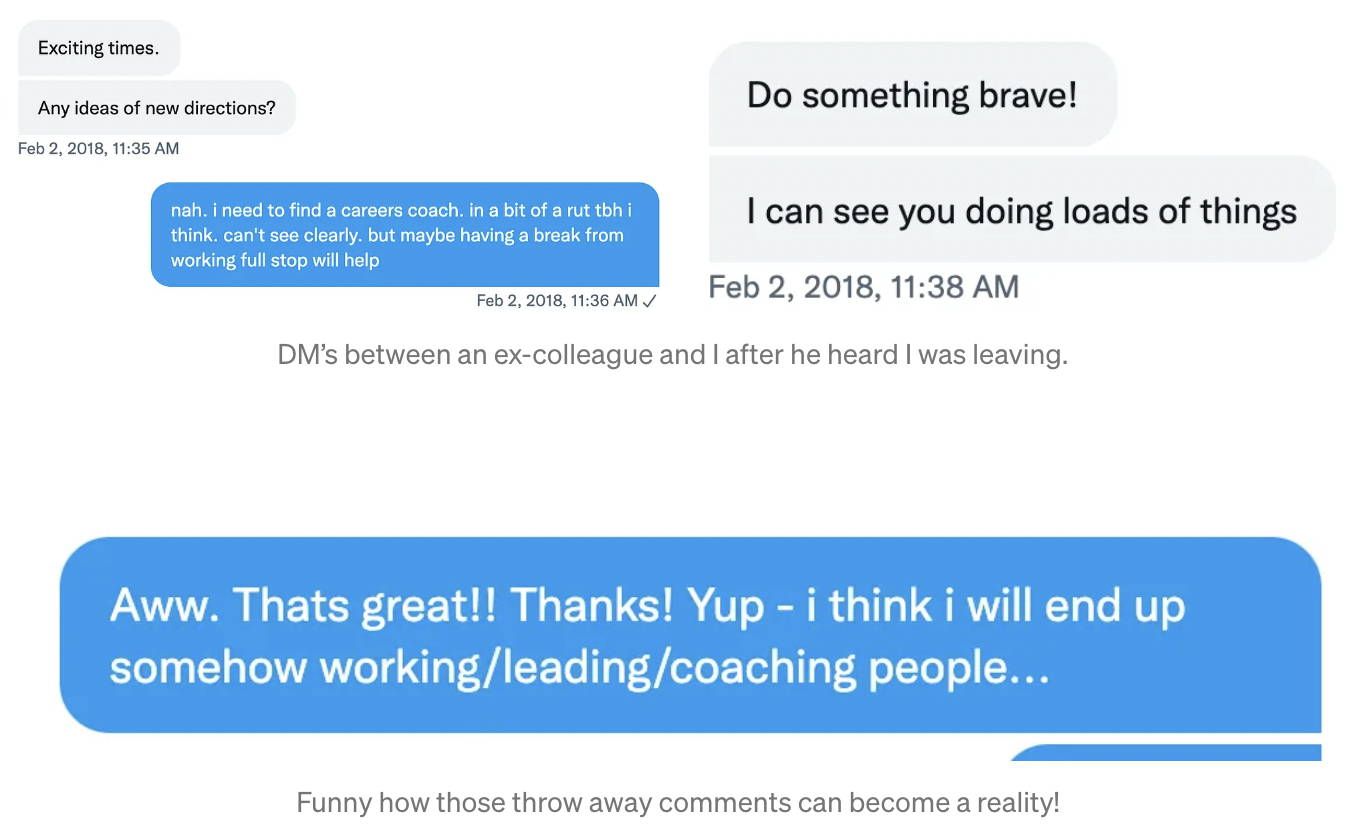
What did I do with that information?
I sat on it.
I thought about it.
I talked about it.
I listened to what friends thought I could do with these skills.
I let myself daydream.
Asked myself ‘but what is your gut telling you?’ and ‘what do you think you would naturally be good at’
and most importantly ‘what don’t you want to do’
And it was that last question that gave me the confidence to embark on a new career.
A Life Coach. This role fits me perfectly, and it’s one I know I am great at.
Changing chapters isn’t easy, but if you feel you are capable of more and don’t want to stay cruising in the same lane forever, I suggest taking the time to listen within to see what emerges.
What words are on your internal merry-go-round? If you are still thinking ‘What else am I capable of?’ ‘I know I can do more, but not sure what that more is’ or ‘if I just had a bit of space to think, I would figure it out..’ then book a free discovery chat with me and let’s work out together why my style of exploratory coaching will help you move out of the slow lane.
What have you got to lose in working on your future whilst living your life?