
What does a life coach actually do?
Ever wondered what a life coach actually does?
This blog explains my approach to life coaching, what happens in a coaching session, who I work with, and why you don't need to have your life figured out before you begin.
Whenever I mention that I'm a life coach, the next question is almost always:
"So... what does a life coach actually do?" It's a fair question.
Coaching is one of those professions that people have often heard of, but many aren't quite sure what actually happens in a coaching session.
Some people imagine being given advice or a step-by-step plan. Others think it's about setting goals, staying accountable or having someone motivate you.
There are coaches who work that way.
I'm not one of them.
The people I work with
I often work with people when something in their life no longer feels right, even if they can't quite explain why. I call it that the fidgety feeling.
From the outside, life may look absolutely fine. They have a good job. A family. Friends. A home. But underneath, something has shifted.
They might be questioning their career. They might be wondering who they are now that life around them has changed. Their relationships may have shifted, or they may simply be asking themselves, "Where do I go from here?"
Often, they don't arrive with a clear question. They just know they can't carry on exactly as they are.
My role isn't to tell you what to do
People are sometimes surprised when I say this. My role is never to tell you what to do or to pretend I have all the answers.
If I simply gave you my opinion, you'd probably leave with my solution rather than discovering what's genuinely right for you.
Instead, my role is to help you untangle what's going on, understand what's changed and why, gently challenge some of the assumptions you're making, and create the space for you to hear yourself think again. That process matters.
Because so much of the time, we're trying to solve today's questions using yesterday's assumptions.
You don't need to have everything figured out first
One of the biggest misconceptions about coaching is that you need to know exactly what you want before you begin.
You don't.
In fact, that's often the very reason people come to coaching. We figure it out together. Clarity doesn't have to come before we begin.
That's what our conversations are for. As we talk, reflect, question and explore, things begin to make sense. Patterns become clearer. Values become easier to recognise. The things that matter most start to stand out.
The next step doesn't suddenly appear because someone tells you what to do. It appears because you've created enough space to hear yourself clearly again.
What people leave with
Every coaching conversation is different because every person is different.
But over time, I often see people leave with something they didn't have when they arrived.
Not necessarily all the answers, but a clearer understanding of themselves.
Greater confidence in their own judgement. Permission to stop living according to old expectations.
And the confidence to make decisions that fit the person they are now, rather than the person they used to be.
Is coaching right for you?
Coaching isn't right for everyone.
If you're looking for someone to give you instructions or tell you exactly what to do next, I'm not the right coach.
But if you've recognised that fidgety feeling - if something no longer fits, if you're questioning what's next, or if you're longing for the space to hear yourself think again - then coaching might be exactly what you need.
You don't have to arrive with a plan.
You don't even have to know what the problem is yet.
We can figure that out together.
If this sounds familiar, I'd love to have a conversation with you. A discovery chat is simply an opportunity to explore what's going on and see whether coaching with me feels like the right fit.
How Life Coaching Works: The Corridor, the Doors and the Dressing-Up Box
How Life Coaching Works | Midlife Coaching Explained.
Curious about life coaching? This article explains how coaching works using two simple metaphors: the corridor and the dressing-up box.

A question I’m asked a lot is:
“So… how does life coaching actually work?”
Good question!
Coaching can feel a bit like smoke and mirrors if you’ve never experienced it.
So instead of giving someone a textbook definition, I usually explain it visually.
Life coaching isn’t advice or therapy. It’s a structured conversation designed to help you think clearly about what you want and how to move towards it.
Imagine this: you and I are standing at the beginning of a long corridor.
At the end of that corridor is a door, behind which is your next chapter. Let’s call it a version of your life that feels more in tune or aligned with who you are now.
You might not know exactly what’s behind that door yet, but you have a sense you want to move towards it, you’re just not sure how to begin.
As we walk down the corridor together, there are doors on the left and right and above each door is a label:
Why am I in this rut?
Why do I feel things could be better?
What kind of job do I actually want?
Where do I want to live?
Am I living how I thought I would be?
Do I stay? Do I leave?
We open a metaphorical door. We go in. We explore (by me asking you questions).
Sometimes you’ll walk out and say, “You know what? I thought I wanted to become an astronaut… but actually, no.” And you close the door.
Other times you might leave the door ajar “That’s interesting. I’m not ready to say yes to that idea, but I’m not saying no either.” There’s no rush. No finger-wagging of “you’ve said this before.”
Instead, I’ll ask the questions you already know need asking but have been too afraid to face.
Why have you been holding onto that idea?
What’s stopped you acting on it before?
What are you afraid might happen?
What would happen if you did it anyway?
The questions aren’t antagonistic, but they are gently challenging. Because it’s in the sticking points that we uncover what’s really going on.
So why not just talk to your friends or family? You can and why don’t you?
But remember, the people who love you come with history, a different perspective and, however well-meaning, their own agenda. They know you as you’ve always been, not who you could be.
Coaching gives you a neutral thinking space.
A place where you can ramble. Change your mind. Say that unfiltered thing out loud without recourse. Admit that you’re bored and restless. Ambitious but lost. Ready but nervous. You get what I’m trying to say.
I don’t judge. I don’t tut-tut at your ideas or say, “But you’ve been saying that for years.”
Working with me is supportive. A safe space to think without a deadline. A place to make sense of and untangle what’s in your head.
The Dressing-Up Box
Another way I explain it is this; imagine a huge dressing-up box. Inside are all your ideas. Career changes. Side projects. New cities. Different lifestyles. A new way of being as you navigate midlife.
Think of each one as an outfit and in coaching, you get to try them on.
Does this fit?
Is this me now or who I used to be?
Does this match the life I actually want?
Am I choosing this because I love it or because I think I should?
Some outfits will feel ridiculous. Some will feel almost right. And eventually, one will feel like your second skin. Comfortable yet tailored. Something that makes you feel confident and more like the present version of you.
Call it clarity if you like (a word the coaching world adores and I tolerate).
Or refer to it as reconnecting with yourself, rediscovering what’s possible, and feeling more in control of the life you’re creating. And who doesn’t want that?
If you’re standing in that corridor right now wondering which door to open next, or circling the same questions and wanting a neutral space to think things through, coaching might help.
Book a discovery chat and we can start opening a few of those doors together.

I know I am capable of more, but what ‘more’ is that?
My subconscious kept trying to shout at me, so I turned up the volume and listened.
Gut feeling. I’ll work it out as I go. Soul searching. Free fall. Figure it out along the way. What else am I capable of? I know I can do more, but what more is that? I just need a bit of space to think.
Do the words above resonate with you? They were on a merry-go-round in mine for about a year whilst figuring out what I should do next.
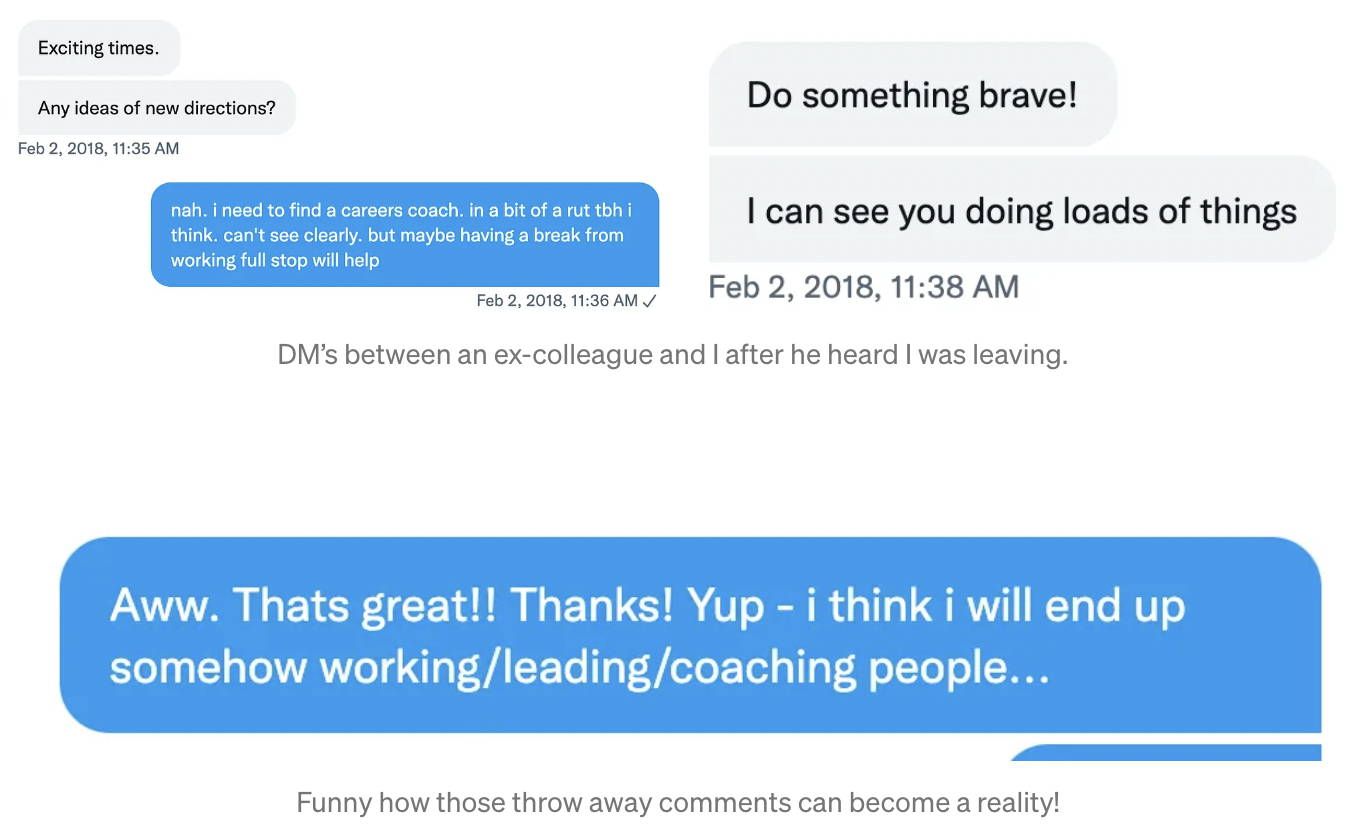
Five years ago I changed career. Not that I knew I was going to change my career when I left my job.
Initially I thought my path would continue along the lines of being a PA and Office Manager but pivoting slightly in whom I would work for. However, my subconscious kept trying to shout at me, so I turned up the volume and listened.
What was my subconscious telling me? That I was good at listening. I enjoyed looking after my colleagues. I was good at picking up on changes in people’s moods and behaviour. It was easy for me to make people feel comfortable and relaxed. I was good at giving a different perspective on situations. Tuning into my intuition was part of my everyday life. A shoulder to cry on; I supported colleagues in their lows as well as highs. I knew the intricacies of people’s personalities and why that resulted in strained relationships between some, yet was harmonious between others. And a fun part for me; I noticed the colleagues who had started romances with one another in secret!
Put all of that in a blender and this is what I saw emerging: People centred. Behaviours. Intuition. Gut feeling. Perspective. Sounding board. Listening post. Sympathetic. Supportive. Empathic. Straight talking. Emotional intelligence.
What did I do with that information?
I sat on it.
I thought about it.
I talked about it.
I listened to what friends thought I could do with these skills.
I let myself daydream.
Asked myself ‘but what is your gut telling you?’ and ‘what do you think you would naturally be good at’
and most importantly ‘what don’t you want to do’
And it was that last question that gave me the confidence to embark on a new career.
A Life Coach. This role fits me perfectly, and it’s one I know I am great at.
Changing chapters isn’t easy, but if you feel you are capable of more and don’t want to stay cruising in the same lane forever, I suggest taking the time to listen within to see what emerges.
What words are on your internal merry-go-round? If you are still thinking ‘What else am I capable of?’ ‘I know I can do more, but not sure what that more is’ or ‘if I just had a bit of space to think, I would figure it out..’ then book a free discovery chat with me and let’s work out together why my style of exploratory coaching will help you move out of the slow lane.
What have you got to lose in working on your future whilst living your life?